Destinations
Fes and Meknes Travel Guide: Exploring Morocco’s Imperial Cities
Fes and Meknes are two of Morocco’s four imperial cities, about 60 km (one hour) apart in the north of the country. Fes is known for Fes el-Bali, a vast medieval medina and UNESCO site since 1981, while Meknes – UNESCO-listed since 1996 – is a calmer city of monumental gates and granaries built by Sultan Moulay Ismail; together with the Roman ruins of Volubilis they make an easy two- to three-day visit.
Fes and Meknes: two imperial cities, one region
Morocco’s imperial cities – Fes, Meknes, Marrakech and Rabat – each served as the capital under different dynasties. Fes and Meknes sit close together on the fertile Saïss plain between the Rif and the Middle Atlas, so they are easy to visit on one trip.
| Fes | Meknes | |
|---|---|---|
| Character | Dense, intense, deeply traditional | Spacious, relaxed, monumental |
| Founded / heyday | Founded around 789; flourished under the Marinids (13th–15th centuries) | Capital under Moulay Ismail (1672–1727) |
| UNESCO listing | Medina of Fes, 1981 | Historic city of Meknes, 1996 |
| Time needed | 2 days minimum | Half to one day |
| Best for | Crafts, madrasas, medina life | Gates, imperial architecture, fewer crowds |
Fes: Morocco’s spiritual and craft capital
Fes el-Bali, the old medina, is a living city of narrow lanes, mosques, fountains, workshops and markets where goods still move by donkey and handcart. It is often described as one of the largest car-free urban areas in the world, and it has been a centre of learning and craftsmanship for more than a thousand years.
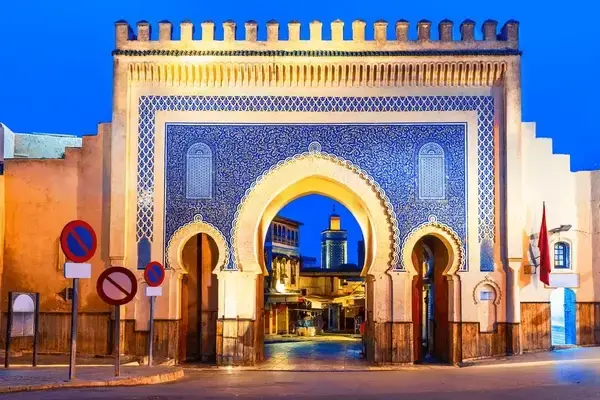
Bab Bou Jeloud
The main western gate into Fes el-Bali, built in 1913, is decorated with blue tiles on the outside and green on the inside. It opens onto the two main streets of the medina, Talaa Kebira and Talaa Seghira, which make good spines for navigation.
Bou Inania and Al-Attarine madrasas
These two 14th-century Marinid theological colleges are among the few religious buildings in Fes that non-Muslims can enter. Both showcase zellige tilework, carved cedar and stucco around peaceful courtyards. Bou Inania near Bab Bou Jeloud is larger; Al-Attarine, beside the spice market, is smaller and exquisitely detailed.
Al-Qarawiyyin
Founded in 859 by Fatima al-Fihri, Al-Qarawiyyin is widely regarded as the oldest continuously operating institution of higher learning in the world. The mosque is closed to non-Muslims, but you can glimpse its courtyard through the doorways. The restored Al-Qarawiyyin library, one of the oldest in the world, occasionally opens part of its building to visitors.
Chouara tannery
The largest of Fes’s tanneries has been working for centuries. From the terraces of surrounding leather shops you look down on honeycomb vats of dye and lime where hides are treated by hand. Mornings are best for activity and light. Shopkeepers will offer mint leaves for the smell; you are under no obligation to buy, though a small tip or purchase is appreciated.
Nejjarine and the craft quarters
The Nejjarine fountain and the Nejjarine Museum of Wooden Arts and Crafts, in a restored caravanserai, are a short walk from the tanneries. Nearby, Seffarine Square rings with the sound of coppersmiths. Further out, the Andalusian quarter across the river and the hilltop Merinid Tombs offer a panoramic view over the medina at sunset.
Meknes: the city of Moulay Ismail
Meknes became the capital under Sultan Moulay Ismail, who ruled from 1672 to 1727 and built an imperial city of walls, gates, palaces and storehouses on a vast scale. Today it is a calm, friendly city with a manageable medina and far fewer visitors than Fes.
Bab Mansour and Place el-Hedim
Bab Mansour, completed in 1732, is one of Morocco’s grandest gates, covered with green and black zellige and framed by columns reused from Volubilis. It faces Place el-Hedim, a large square that comes alive in the evening with families, snack stalls and street entertainers.
Mausoleum of Moulay Ismail
The sultan’s tomb is one of the few active religious sites in Morocco where non-Muslims have traditionally been allowed into the outer courtyards and the antechamber, with its fountains and tilework. Dress modestly and check opening times locally, as access can change during restoration work.
Heri es-Souani granaries and stables
This immense complex of vaulted storehouses was built to keep grain and water for the imperial city, using thick walls and underground water channels to keep it cool. The adjoining stables are said to have housed thousands of horses. The rows of arches are impressive in scale and quiet, especially in the morning.
Meknes medina
The souks behind Place el-Hedim are compact and relaxed, good for textiles, olives and the city’s damascene metalwork, in which silver thread is hammered into iron.
Day trip to Volubilis and Moulay Idriss
Volubilis, about 30 km from Meknes (40 minutes) and around 1.5 hours from Fes, is the best-preserved Roman site in Morocco and a UNESCO World Heritage Site since 1997. Walk the main street, the Decumanus Maximus, to the triumphal arch and the basilica, and look out for floor mosaics showing Orpheus, Bacchus and the labours of Hercules in the houses on either side.
A few kilometres away, the hillside town of Moulay Idriss Zerhoun is one of Morocco’s most important pilgrimage sites, built around the tomb of Idriss I, founder of the first Moroccan Islamic dynasty. Non-Muslims cannot enter the shrine, but the climb to the viewpoint above the town is worth it.
How many days in Fes and Meknes?
- One day: a guided half-day in Fes el-Bali plus the tanneries. Rushed, but possible.
- Two days: two days in Fes, or one in Fes and one for Meknes and Volubilis.
- Three days: two in Fes at a comfortable pace plus a full day for Meknes, Volubilis and Moulay Idriss. This is the ideal amount.
Many multi-day tours start in Fes and head for the Sahara via the Middle Atlas. The 3-day desert tour from Fes is the shortest option, and the 4-day Fes to Marrakech desert tour adds a more relaxed pace through the gorges. For a broader loop that also takes in Meknes, Volubilis, Chefchaouen and Rabat, look at the 7-day tour from Fes.
Practical tips for Fes and Meknes
- Getting there: trains link Fes and Meknes with Rabat, Casablanca, Tangier and Marrakech. Fes–Meknes takes about one hour by road or train.
- Where to stay: a riad in Fes el-Bali for atmosphere, ideally near a gate with taxi access such as Bab Bou Jeloud or the Batha area. In Meknes, guesthouses near Place el-Hedim are convenient.
- When to go: spring and autumn are best. Fes is hot in July and August and cold on winter nights.
- Fridays: many shops in the Fes medina close for part of Friday, so plan workshop visits for other days.
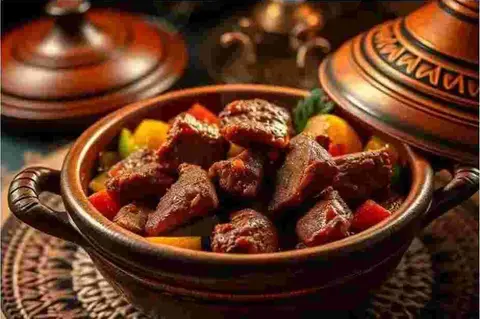
- Food: Fes is known for pastilla and its refined cuisine – see our Moroccan food guide.
Frequently asked questions
Is it better to visit Fes or Meknes?
If you only have time for one, choose Fes, which has the more extraordinary medina, the madrasas and the tanneries. Meknes is better if you prefer a quieter city with grand gates and fewer crowds. Ideally, combine them: Meknes is only about an hour from Fes and pairs naturally with Volubilis on a day trip.
How far is Meknes from Fes?
Meknes is about 60 km west of Fes, roughly one hour by road or train. That makes it easy to visit Meknes as a day trip from Fes, usually combined with the Roman ruins of Volubilis and the town of Moulay Idriss, which lie about 30 km north of Meknes.
Do I need a guide in the Fes medina?
You do not need one, but a licensed guide is highly recommended for your first visit. Fes el-Bali is a maze of thousands of lanes with few signposts, and a guide helps you find the madrasas, tanneries and workshops efficiently while keeping unofficial guides away. Book through your riad or tour operator and agree the duration in advance.
How many days do you need in Fes?
Two full days is the ideal minimum for Fes. That allows a guided day in the medina covering Bou Inania, Al-Attarine, the tanneries and Nejjarine, and a second day for the Andalusian quarter, the Merinid Tombs viewpoint and independent wandering. Add a third day for Meknes and Volubilis.
Can you visit Volubilis from Fes?
Yes. Volubilis is around 1.5 hours’ drive from Fes, so it makes a comfortable day trip, usually combined with Meknes and Moulay Idriss. Allow two hours at the site itself. Go early or late in the day in summer, as there is very little shade among the ruins.
Published · Updated