Overview
This Morocco student tour is built for school and university groups who want to see how the country’s history fits together on the ground. In eight days you move from the Atlantic cities of Casablanca and Rabat to the Roman town of Volubilis, the imperial city of Meknes and the medieval medina of Fes, then cross the Middle Atlas to the Sahara and return over the High Atlas to Marrakech.
Each day has a clear theme that teachers can link to their programme: Roman North Africa, Islamic architecture and urban life, Amazigh (Berber) culture in the mountains and oases, and how people, plants and animals adapt to the desert. Local guides lead the medina visits in Fes and Marrakech, and your driver explains the landscapes between the stops.
The tour is private, so the pace, room plan and daily timings are set around your group, and accompanying teachers can ask us to adjust visits to fit a syllabus.
Itinerary checked: · Travel Tours Morocco
Highlights
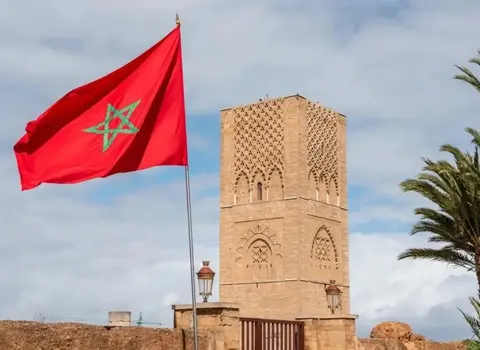
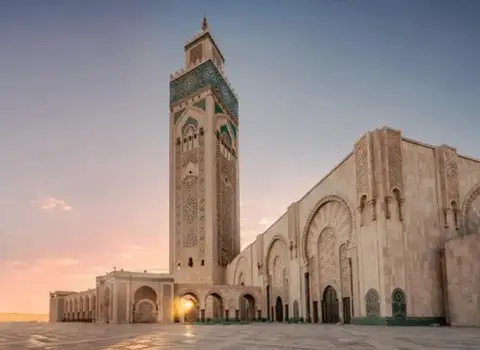
- The Hassan II Mosque in Casablanca and Rabat’s Hassan Tower, Mausoleum of Mohammed V and Kasbah of the Udayas
- Roman Volubilis (UNESCO, 1997), with its mosaics, forum and triumphal arch
- Meknes (UNESCO, 1996) and the monumental Bab Mansour gate
- A guided day in the Fes medina (UNESCO, 1981): madrasas, souks and the Chouara tannery
- Cedar forests and Barbary macaques in the Middle Atlas, then the Ziz Valley palm groves
- Camel ride into the Erg Chebbi dunes and a night at a desert camp
- A desert-ecology and Amazigh culture day around Merzouga, including Gnawa music in Khamlia
- Todra Gorge, the Dades Valley and the earthen ksar of Aït Ben Haddou (UNESCO, 1987)
Places you’ll visit
- Casablanca
- Rabat
- Meknes
- Volubilis
- Fes
- Ifrane
- Midelt
- Ziz Valley
- Merzouga
- Erg Chebbi
- Khamlia
- Tinghir
- Todra Gorge
- Dades Valley
- Ouarzazate
- Aït Ben Haddou
- Tizi n’Tichka
- Marrakech
Day-by-day itinerary
Day 1Arrival in Casablanca – Hassan II Mosque – Rabat
Your driver meets the group at Mohammed V Airport or your Casablanca hotel. The first visit is the Hassan II Mosque, built partly over the Atlantic; it is one of the few mosques in Morocco that non-Muslims can enter on a guided visit, at set times.
In the afternoon you drive up the coast to Rabat, the capital. Students see the unfinished 12th-century Hassan Tower, the Mausoleum of Mohammed V and the white-and-blue lanes of the Kasbah of the Udayas above the river mouth – a compact introduction to Morocco’s dynasties and its modern state.
Day 2Rabat – Meknes – Volubilis – Fes
You leave Rabat for Meknes, about two hours inland. Here the group sees Bab Mansour, the great gate of Sultan Moulay Ismail’s 17th-century capital, and walks the old granaries and stables area if time allows.
A short drive brings you to Volubilis, the best-preserved Roman site in Morocco. Walking between the forum, the basilica and the houses with their floor mosaics is a very direct way to understand how far the Roman world reached into North Africa.
You continue to Fes, arriving in the late afternoon.
Day 3Fes: guided day in the medina
A licensed local guide leads the group through Fes el-Bali, a UNESCO World Heritage Site since 1981, where goods are still moved by donkey and handcart through lanes too narrow for cars. You enter through Bab Bou Jeloud and visit a medieval madrasa such as Bou Inania or Al-Attarine, where the carved cedar, stucco and tilework make Islamic architecture easy to read.
Students pass the Al-Qarawiyyin mosque and university, founded in the 9th century, and see the Chouara tannery from a terrace. The souks are grouped by trade – metalworkers, weavers, dyers – which makes a good starting point for a discussion of crafts, guilds and the economy of a historic city.
Day 4Fes – Ifrane – Middle Atlas – Midelt – Ziz Valley – Merzouga
This is the longest day of the tour, so you leave Fes early. The road climbs to Ifrane, a mountain town nicknamed “Little Switzerland”, and through the cedar forests near Azrou, where you can usually see Barbary macaques.
South of Midelt the landscape dries out, and the Ziz Valley appears as a long green line of date palms below the road – a clear example of an oasis fed by a river in an arid region.
At Merzouga the group rides camels into the Erg Chebbi dunes at sunset while the luggage goes to camp by 4×4. Dinner, drumming and a night sky with little light pollution end the day.
Day 5Merzouga: desert ecology and Amazigh culture day
Students can climb a dune for sunrise before breakfast. During the morning a local guide explains how the dunes of Erg Chebbi, which rise to roughly 150 m, are shaped by the wind, and which plants, insects and reptiles live in and around them.
Later you visit Khamlia, a village known for Gnawa music, whose roots link Morocco with sub-Saharan Africa, and meet a nomadic family to talk about herding, water and how life in the desert is changing. The group can also try sandboarding on the dunes.
The night is spent in a hotel or auberge in Merzouga, which gives everyone a shower, a proper bed and time to rest before the next drive.
Day 6Merzouga – Tinghir – Todra Gorge – Dades Valley
You drive west past Erfoud and Tinghir, stopping above Tinghir’s palm oasis, where traditional earth-built villages sit on the edge of irrigated gardens.
In the Todra Gorge the group walks between limestone walls up to about 300 m high – a good place to talk about erosion and the role of rivers in shaping the landscape. You continue to the Dades Valley for the night.
Day 7Dades Valley – Ouarzazate – Aït Ben Haddou – Tizi n’Tichka – Marrakech
The road follows the Valley of Roses and the Skoura oasis to Ouarzazate, then on to Aït Ben Haddou. This fortified ksar, a UNESCO World Heritage Site since 1987, shows how Amazigh communities built defensive villages in rammed earth along the old caravan routes.
In the afternoon you cross the High Atlas on the Tizi n’Tichka pass at 2,260 m and descend to Marrakech, arriving in the early evening.
Day 8Marrakech guided visit – departure
A local guide takes the group through the Marrakech medina, a UNESCO World Heritage Site since 1985. Typical visits include the Koutoubia mosque (from outside), the Bahia Palace and the Ben Youssef Madrasa, finishing at Jemaa el-Fna square.
After the visit your driver takes the group to Marrakech Menara Airport or onward accommodation. If your flight leaves early, the guided visit can be moved to the evening of day 7.
View the journey on the map
Follow the main travel path, key stops and overnight destinations on an interactive road map. Total driving: ~1,427 km.
Loading map…
- Day 1 · Casablanca → Hassan II Mosque → Rabat (~101 km)
- Day 2 · Rabat → Meknes → Volubilis → Fes (~268 km)
- Day 3 · Fes
- Day 4 · Fes → Ifrane → Midelt → Ziz Valley → Merzouga (~462 km)
- Day 5 · Merzouga
- Day 6 · Merzouga → Tinghir → Todra Gorge → Dades Valley (~279 km)
- Day 7 · Dades Valley → Ouarzazate → Aït Ben Haddou → Tizi n’Tichka → Marrakech (~317 km)
- Day 8 · Marrakech
Routes and distances are approximate, based on OpenStreetMap roads; the exact road can vary with conditions on the day.
Accommodation options
| Level | Property | Location |
|---|---|---|
| Night 1 – Rabat | ||
| Standard (3★) | 3★ hotel in Rabat with twin and triple rooms | Rabat |
| Superior (4★) | 4★ hotel in Rabat | Rabat |
| Nights 2–3 – Fes | ||
| Standard (3★) | 3★ riad or hotel in or near the Fes medina | Fes |
| Superior (4★) | 4★ hotel in Fes | Fes |
| Night 4 – Merzouga desert camp | ||
| Standard | Standard desert camp with shared tents | Erg Chebbi, Merzouga |
| Mid-range | Desert camp with private-bathroom tents | Erg Chebbi, Merzouga |
| Night 5 – Merzouga | ||
| Standard (3★) | Hotel or auberge in Merzouga with twin and triple rooms | Merzouga |
| Night 6 – Dades Valley | ||
| Standard (3★) | 3★ hotel or auberge in the Dades Valley | Boumalne Dades |
| Night 7 – Marrakech | ||
| Standard (3★) | 3★ riad or hotel in Marrakech | Marrakech |
| Superior (4★) | 4★ hotel in Marrakech | Marrakech |
Examples by level, subject to availability; we may suggest an equivalent alternative.
What’s included
- Private air-conditioned vehicle(s) with driver for the whole tour, sized to your group
- Fuel, road tolls and parking
- Seven nights’ accommodation in 3★–4★ hotels, riads and a desert camp, with students in shared twin or triple rooms
- Daily breakfast and dinner, as shown in the itinerary
- Licensed local guides for the Fes and Marrakech medinas
- Local guide for the desert-ecology morning in Merzouga
- Camel ride into Erg Chebbi and sandboarding
- Visits to Khamlia and a nomadic family near Merzouga
- Airport pickup in Casablanca and drop-off in Marrakech
Not included
- International flights
- Travel and medical insurance
- Lunches, drinks and snacks
- Entrance fees to monuments and museums (we can quote them as a group package on request)
- Optional activities such as quad biking
- Tips for drivers and guides (optional)
- Personal expenses
Good to know
- Accompanying teachers or group leaders remain responsible for supervising students; our drivers and local guides lead the visits and logistics.
- Day 4 (Fes to Merzouga) is the longest drive, about 470 km, with regular rest stops.
- Modest dress – shoulders and knees covered – is expected at religious sites and appreciated in rural villages.
- Desert nights are cold from November to March; students should bring a warm layer and a small overnight bag for camp.
- We send a day-by-day plan with timings that teachers can use for school paperwork and parent briefings.
Who this tour suits
Designed for secondary-school and university groups travelling with their own teachers or group leaders. The walking is moderate – mostly medina streets, Volubilis and a short gorge walk – and there is one long driving day to the Sahara. Groups larger than one vehicle travel in several vehicles or a coach, which we confirm in your quote.
Make it yours
On request we can shift the focus towards history, geography, religion and architecture or languages, add a lecture or Q&A with a local guide, include Chefchaouen, or reverse the route to start in Marrakech. Shorter groups may prefer the 5-day student Sahara trip. Tell us the age range, numbers and learning aims and we will suggest a programme.
Frequently asked questions
Who supervises the students during the tour?
Your accompanying teachers or group leaders supervise the students at all times, as on any school trip abroad. Our role is the travel itself: a driver for each vehicle, local guides for the medinas and the desert, and a planned schedule with clear meeting points. We share contact numbers and the daily plan before departure so teachers always know who to call.
How are rooms shared on a student tour?
Students normally share twin or triple rooms, split by gender, and teachers can have their own rooms nearby. In the desert camp, tents may be shared by three or four. Send us your rooming list a few weeks before travel and we will pass it to each hotel, so that the group is placed together on the same floor where the hotel allows it.
Is Morocco safe for a school or university group?
Morocco is a popular destination for international school and university groups, and this tour uses private vehicles, licensed local guides and established hotels throughout. As with any trip abroad, teachers should check their government’s travel advice, arrange travel insurance and brief students on behaviour in crowded medinas. We are happy to answer questions for your school’s risk assessment.
Can you cater for dietary needs and allergies?
Yes, in most cases. Vegetarian meals are easy to arrange across Morocco, and hotels and camps can usually cater for allergies and other diets if they know in advance. Send us each student’s requirements with your rooming list, and teachers should still check dishes on the day, especially for nut or gluten allergies.
How much does a Morocco student tour cost?
We quote each student group individually, because the price per person depends mainly on group size, travel dates, hotel level and the number of vehicles. Shared rooms and 3★ hotels keep costs down. Send us your approximate numbers, ages and dates, and we will reply with a per-person price and a list of what is included.
What is the minimum age for this tour?
There is no strict minimum age for the tour itself, but the programme is designed for secondary-school and university students who can manage long drives and full days of visits. Some activities, such as quad biking, have their own age limits, which we confirm in your quote. For younger pupils we can shorten the days.