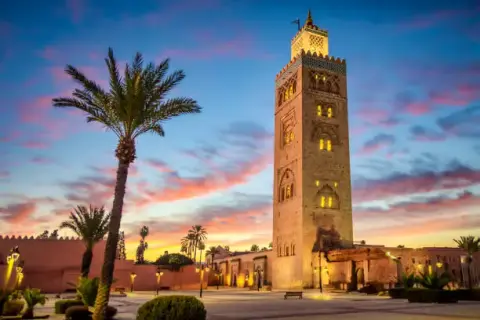
Sahara Desert
Sahara Desert Morocco Guide: Merzouga, Camel Treks and Desert Camps
The most popular place to experience the Sahara desert in Morocco is Merzouga, a village beside the Erg Chebbi dunes, which rise to roughly 150 m. A typical visit includes a sunset camel ride into the dunes, dinner and a night in a desert camp, and sunrise the next morning; most travellers arrive on a 2–3 day tour from Marrakech or Fes, as Merzouga is about 560 km from Marrakech and 470 km from Fes.
Where to see the Sahara desert in Morocco
Most of Morocco’s Sahara is stony desert – gravel plains, dry riverbeds and rocky plateaus called hamada. The sand seas, or ergs, that most people picture are smaller and scattered. Choosing the right one makes a big difference to your trip.
| Desert area | Getting there | Dunes | Best for |
|---|---|---|---|
| Erg Chebbi (Merzouga) | Paved road to Merzouga; about 560 km from Marrakech, 470 km from Fes | High, golden dunes up to roughly 150 m | First-time visitors, the classic dune experience, wide choice of camps |
| Erg Chigaga (beyond M’Hamid) | Paved to M’Hamid, then 55–60 km off-road by 4×4 (1.5–2 hours) | Large, remote dune field | Travellers wanting fewer people and a more adventurous approach |
| Zagora area | About 360 km from Marrakech via Ouarzazate and the Draa Valley | Small dunes and stony desert | Short trips with limited time; Draa Valley palm groves |
| Agafay (near Marrakech) | About 45 minutes from Marrakech | No dunes – stony hills | An evening desert atmosphere without the long drive |
This guide focuses on Merzouga and Erg Chebbi, where most desert tours and activities in Morocco take place.
Merzouga and the Erg Chebbi dunes
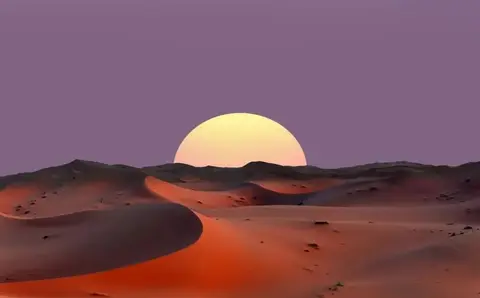
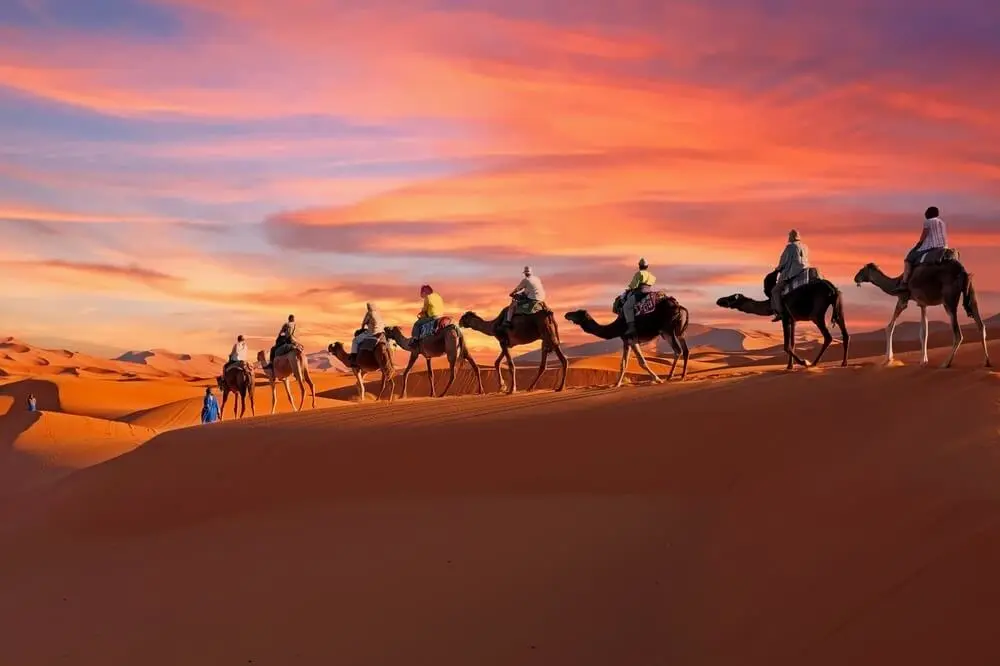
Merzouga is a small village on the western edge of Erg Chebbi, a dune field roughly 22 km long and up to about 5 km wide. The dunes change colour through the day, from pale gold at noon to deep orange and red at sunset, and the highest reach roughly 150 m.
Around the dunes you will find the market town of Rissani, the fossil workshops of Erfoud, the seasonal lake of Dayet Srji (which attracts flamingos in wet years), and the village of Khamlia, home to a Gnaoua community whose music has roots in sub-Saharan Africa.
The camel trek and a night in the dunes
What a typical desert night looks like
- Late afternoon: arrive in Merzouga, leave your main luggage in the vehicle or at a hotel, and take a small overnight bag.
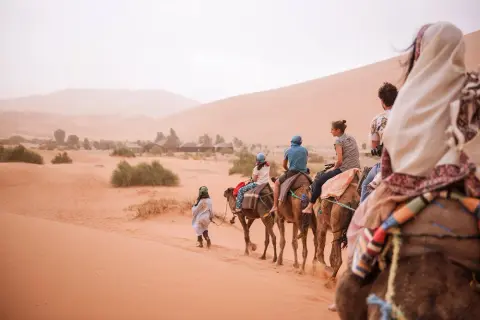
- Sunset: ride a dromedary into the dunes with a camel handler leading on foot, usually for about 1–1.5 hours. Stop on a ridge to watch the sun go down.
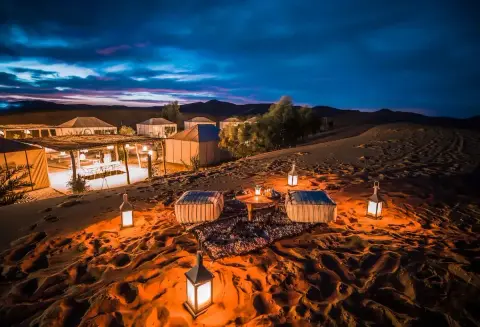
- Evening: arrive at camp for mint tea and dinner, often harira, salads and a tagine, followed in many camps by drumming and music around the fire.
- Night: stargazing – with no light pollution, the Milky Way is clearly visible on moonless nights.
- Sunrise: climb a dune to watch the sun rise, then ride or walk back to Merzouga for breakfast.
If one night is not enough, multi-night camel treks take you deeper into the erg, sleeping in simpler nomad-style camps. The 2-night camel trek in Merzouga is a good option for travellers who want real time in the desert rather than an overnight stop.
Standard and luxury desert camps
- Standard camps: traditional tents with beds and blankets, shared toilets and showers, and communal dinners. Simple and atmospheric.
- Luxury camps: spacious private tents with proper beds, en-suite bathrooms with hot showers and flush toilets, electricity, and more elaborate meals. Some offer heating or extra blankets in winter.
Both types are usually reached by camel, with luggage brought separately by 4×4. If you are already in the area, the Merzouga overnight desert camp experience combines the camel ride, dinner and a night in the dunes without a full tour. Our accommodation guide compares camps with riads and kasbahs.
Other things to do in Merzouga
- Sandboarding: many camps lend boards for sliding down the dunes.
- Quad biking and buggies: guided rides around the edge of the dunes, such as the ATV quad tour in Merzouga.
- 4×4 excursions: a day circuit around Erg Chebbi to Khamlia, Rissani, nomad encampments and Dayet Srji.
- Visiting nomad families: some tours include tea with a nomadic family living around the dunes.
- Stargazing and sunrise: free, and for many travellers the best part of the trip.
How to get to Merzouga
Merzouga is far from the main cities, so most travellers come on an organised tour or with a private driver. The distances below are approximate, by road.
| From | Route | Distance | Typical tour length |
|---|---|---|---|
| Marrakech | Tizi n’Tichka, Aït Ben Haddou, Ouarzazate, Dades, Todra | About 560 km | 2 days (fast), 3 days (comfortable) |
| Fes | Ifrane, Midelt, Ziz Valley, Erfoud | About 470 km, 7.5–8.5 hours | 2–3 days |
| Ouarzazate | Skoura, Dades Valley, Todra Gorge | About 360 km, 6–7 hours | 2 days |
| Errachidia | Erfoud | About 135 km, 2 hours | 1–3 days |
From Marrakech, the 3-day Marrakech desert tour is the most popular choice, with a night in the Dades Valley on the way. If you want to continue north rather than return, the 3-day Fes to Marrakech desert tour covers the same highlights in the opposite direction.
When to go and what to pack
March to May and late September to November are the most comfortable months, with warm days and cool nights. Winter days are pleasant, but nights near freezing make warm clothing essential. In June, July and August, daytime temperatures often exceed 40°C, so activities move to early morning and evening. See our guide to the best time to visit Morocco for monthly averages.
- Light, loose clothing for the day and warm layers for night
- Scarf or cheich (desert turban), sunglasses and high-factor sunscreen
- Closed shoes or sandals with a strap
- Small backpack for the camel ride: water, torch, power bank, toiletries, medication
- Wet wipes and a bag for your rubbish
Frequently asked questions
How far is Merzouga from Marrakech?
Merzouga is about 560 km from Marrakech, roughly 9–10 hours of driving without stops. Most tours split the journey, usually with a night in the Dades Valley after crossing the High Atlas, visiting Aït Ben Haddou on the way. That is why the most popular Marrakech desert tours last three days rather than one or two.
Is Erg Chigaga or Merzouga better?
Merzouga’s Erg Chebbi is better for most first-time visitors: it is reached by paved road, has the highest and most photogenic dunes in Morocco, and offers a wide choice of camps. Erg Chigaga is better if you want remoteness, as it is reached only by 4×4 from M’Hamid and sees fewer visitors, but the journey is longer and rougher.
How long is the camel ride in Merzouga?
The camel ride from the edge of the dunes to an overnight camp usually takes around 1 to 1.5 hours, timed so that you watch the sunset on the way. Many tours include a shorter ride back at sunrise. Multi-night camel treks involve several hours of riding and walking each day, deeper into the Erg Chebbi dunes.
Is it cold at night in the Sahara?
Yes, the desert cools quickly after sunset. Even in spring and autumn, nights can be cool, and between December and February temperatures in the Merzouga dunes can approach freezing. Camps provide thick blankets, but bring a fleece or down jacket, warm trousers, socks and a hat to stay comfortable outside.
Can you visit the Sahara on a day trip?
Not from Marrakech or Fes, as the dunes are too far away. If you are already in the area – staying in Merzouga, Erfoud or Rissani – you can join activities such as a sunset camel ride, quad biking or a 4×4 tour around Erg Chebbi without staying overnight. Near Marrakech, the stony Agafay desert offers a short taste of desert scenery.
Do desert camps in Merzouga have electricity and Wi-Fi?
Most established camps have electricity, often solar-powered, for lighting and phone charging, especially luxury camps with en-suite tents. Wi-Fi and mobile signal vary from good to none depending on the camp’s location in the dunes. It is best to treat the night as a chance to disconnect and bring a power bank.
Published · Updated